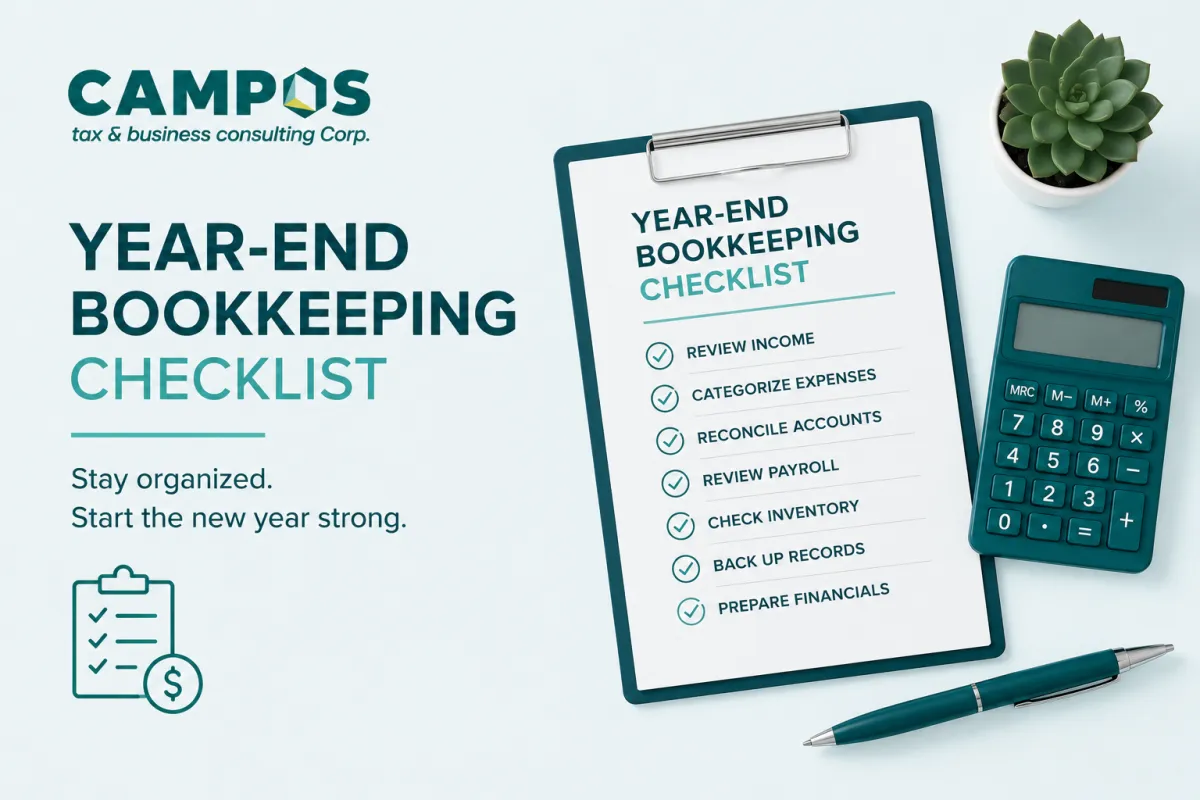
Year-End Bookkeeping Checklist for Canadians 2026
“The CRA requires corporations to maintain financial records for a minimum of six years from the end of the last tax year they relate to.”
Table of Content: Year-End Bookkeeping Checklist for Canadian Corporations
Year-End Bookkeeping Checklist for Canadian Corporations: A Complete Guide for 20261
Why Year-End Bookkeeping Matters for Canadian Corporations1
Step 1: Lock Your Fiscal Year and Communicate with Stakeholders1
Step 2: Reconcile All Financial Accounts2
Step 3: Review and Record Accrued Expenses3
Step 4: Review and Record Prepaid Expenses4
Step 5: Fixed Asset and Depreciation Review5
Step 6: Complete Payroll and Source Deduction Reconciliation6
Step 7: Reconcile GST/HST Accounts7
Step 8: Prepare Year-End Trial Balance and Financial Statements8
Step 9: Document and Organize Supporting Records9
Step 10: Coordinate with Your Corporate Tax Accountant10
How Professional Bookkeeping Services Simplify Year-End2
Other resources to help you get started with HST Registration2
Question 1: What is the deadline for corporate year-end bookkeeping in Canada?1
Question 2: What happens if I miss the corporate tax filing deadline?2
Question 3: What records should I keep for my corporation?3
Question 4: Do I need financial statements prepared for corporate tax filing?4
Question 5: What is the difference between compiled and reviewed financial statements?5
Question 6: How can I reduce year-end stress for my corporation?6
Year-End Bookkeeping Checklist for Canadian Corporations: A Complete Guide for 2026
For incorporated businesses in Canada, year-end bookkeeping is not optional — it is the essential process that transforms scattered financial data into organized records ready for corporate tax filing. Yet many business owners approach year-end with anxiety because they have not maintained consistent bookkeeping throughout the year, or they do not understand exactly what needs to be completed before their accountant can prepare the T2 return.
This year-end bookkeeping checklist for Canadian corporations removes that anxiety. It provides a clear, actionable roadmap for everything your business needs to complete before tax season arrives. Whether you handle bookkeeping internally or work with a professional bookkeeper, this checklist ensures nothing is missed.
For businesses in Oakville, Burlington, Mississauga, Milton, and across the GTA, following this checklist means entering corporate tax season with organized books, clear financial understanding, and minimal stress.

With that said, here are the best steps regarding Year-End Bookkeeping for Canadian Business Owners!
Why Year-End Bookkeeping Matters for Canadian Corporations
Your year-end bookkeeping process accomplishes several critical objectives. First, it reconciles all your financial accounts — bank statements, credit cards, loans, and receivables — to ensure your recorded balances match actual amounts. Second, it captures all transactions that occurred during the fiscal year so nothing is omitted from your corporate tax filing. Third, it generates the trial balance and financial statements your accountant needs to prepare an accurate T2 return.
corporations with December 31 year-ends face a June 30 deadline for T2 filing, while corporations with other fiscal year-ends must file within six months of their year-end date. These timelines mean planning must begin months before the actual deadline.
The condition of your year-end books directly affects how quickly and accurately your corporate tax return can be prepared. Clean, organized books mean your accountant can complete the T2 return efficiently and identify legitimate deductions. Messy books mean your accountant spends time cleaning up records instead of optimizing your tax position — and you may miss deductions because documentation is insufficient.
Step 1: Lock Your Fiscal Year and Communicate with Stakeholders
Before beginning any year-end tasks, confirm your corporation's fiscal year-end date. This date appears in your corporate records and determines both your year-end tasks and your tax filing deadline. If you are uncertain, check with your accountant or review corporate filings.
Actions to complete:
Confirm the fiscal year-end date with all stakeholders
Notify your accountant of the approaching year-end and request their year-end requirements
If using external bookkeepers or accountants, schedule time for document transfer and review
Ensure your accounting software fiscal year settings are correct before entering any adjustments
For corporations planning to extend their filing deadline, note that extensions provide additional time for filing but do not extend the deadline for payment of any balance owing. Tax payments are still due by the original filing deadline.
Step 2: Reconcile All Financial Accounts
Account reconciliation is the foundation of accurate year-end books. Every account with a statement — bank accounts, credit cards, lines of credit, loans, mortgages — must be reconciled to ensure the balance in your accounting system matches the actual balance.
Bank account reconciliation:
Obtain final bank statements for the fiscal year for all accounts
Compare each transaction in your accounting system to the bank statement
Identify and investigate any discrepancies immediately
Record any bank fees, interest, or other transactions not yet entered
Confirm the reconciled balance matches the bank statement ending balance
Credit card and loan reconciliation:
Obtain final credit card statements for the fiscal year
Reconcile similarly to bank accounts, matching each transaction
Record interest charges and fees not yet entered
Confirm balances match statements after reconciliation
Accounts receivable and payable review:
Review open invoices and ensure customer statements have been sent
Identify old receivables and determine collectability
Confirm outstanding payables match vendor records
Identify any credits or adjustments needing processing
Reconciliation identifies errors early, giving time to investigate and correct them before year-end books are finalized. Waiting until tax season to discover discrepancies creates unnecessary stress and potential filing delays.
Account reconciliation is easier with professional support. Our bookkeeping services keep your accounts organized throughout the year. Book a FREE consultation
Step 3: Review and Record Accrued Expenses
Accrued expenses are costs your business has incurred but not yet recorded or paid. Proper accrual ensures your financial statements reflect the true expenses of the fiscal year, not just the cash payments made.
Common year-end accruals:
Accrued interest on loans and lines of credit
Accrued professional fees (legal, accounting) not yet invoiced
Accrued utility expenses for the final portion of the fiscal year
Accrued vacation pay for employees
Accrued bonuses or commissions earned but not yet paid
Your accountant can provide a list of accruals appropriate for your business based on industry and circumstances. Recording these before year-end ensures your income statement accurately reflects expenses for the fiscal year.
Step 4: Review and Record Prepaid Expenses
Prepaid expenses represent payments made in advance for future benefits. At year-end, you must determine how much of each prepaid expense applies to the current fiscal year versus future periods.
Common prepaid expense categories:
Insurance premiums paid annually or semi-annually
Prepaid rent or lease payments
Subscriptions and memberships with upcoming renewal dates
Deposits paid for services not yet received
The portion of each prepaid expense that relates to the next fiscal year should be recorded as a prepaid asset on your balance sheet, not expensed in the current year. This adjustment ensures your income statement reflects only the actual expenses incurred during the fiscal year.

Step 5: Fixed Asset and Depreciation Review
For corporations with fixed assets — equipment, vehicles, furniture, buildings — year-end is the time to review depreciation and ensure all acquisitions and disposals are recorded.
Fixed asset year-end tasks:
Review all asset acquisitions during the fiscal year and ensure they are recorded
Identify any assets disposed of, sold, or removed from service
Confirm depreciation calculations are accurate for each asset
Consider whether capital cost allowance (CCA) claims should be maximized or optimized for tax purposes
Document any assets requiring separate tracking for GST/HST rebates
Your accountant often has specific preferences for how fixed assets are categorized and depreciated for both accounting and tax purposes. Confirm these preferences before finalizing your year-end books.
Step 6: Complete Payroll and Source Deduction Reconciliation
Payroll is one of the most complex year-end processes because it involves multiple government filings and year-end documents for employees and the CRA.
Payroll year-end tasks:
Confirm all payroll periods are recorded and reconciled
Verify Canada Pension Plan (CPP) and Employment Insurance (EI) deductions are accurate
Ensure all employee addresses and social insurance numbers are current
Confirm Records of Employment have been issued for any employees who departed
Review director compensation and ensure it has been properly recorded
T4 and T4A preparation:
Generate T4 slips for all employees, including the summary
Generate T4A slips for contractors and other recipients of non-employment income over the threshold
Reconcile payroll expense totals to the general ledger
Ensure CPP and EI deductions match Canada Revenue Agency requirements
Filing deadline: T4 and T4A slips must be filed with the CRA by the last day of February following the fiscal year-end. For December 31 year-ends, this means February 28 (or 29 in a leap year).
T4 and T4A filing requires accuracy and attention to detail. We help ensure your payroll year-end is complete and compliant. Book a FREE consultation
Step 7: Reconcile GST/HST Accounts
If your corporation is registered for GST/HST, year-end requires reconciliation of these accounts to ensure proper input tax credit tracking and accurate GST/HST returns.
GST/HST year-end tasks:
Review all GST/HST returns filed during the fiscal year
Reconcile GST/HST collected on sales to the general ledger
Reconcile input tax credits claimed to supporting documentation
Identify any additional input tax credit opportunities before year-end
Confirm GST/HST accounts are up to date with the final reporting period
Some businesses have CRA reassessments or adjustments from prior periods that need to be recorded. Your accountant should review any such adjustments and ensure they are properly reflected in the books.
Step 8: Prepare Year-End Trial Balance and Financial Statements
Once all reconciliations, accruals, and adjustments are complete, your accounting software can generate the year-end trial balance. This document is the foundation for financial statement preparation and corporate tax filing.
Trial balance review:
Verify total debits equal total credits
Review unusual account balances that may indicate errors
Confirm all balance sheet accounts have reasonable balances
Ensure income and expense accounts reflect the full fiscal year
Financial statement preparation:
Generate balance sheet as of year-end date
Generate income statement (statement of earnings) for the fiscal year
Generate cash flow statement if required or beneficial
Review comparative figures from prior year for reasonableness
For corporations requiring reviewed or compiled financial statements for lenders, investors, or other stakeholders, your accountant will prepare these from your finalized books. Ensuring books are clean before this step prevents delays and additional costs.
Need help preparing financial statements for your corporation? Our team ensures accurate reporting for tax filing and stakeholder needs. Contact Campos Tax & Business Consulting Corp.
Step 9: Document and Organize Supporting Records
The CRA requires corporations to maintain financial records for a minimum of six years from the end of the last tax year they relate to. Year-end is an appropriate time to organize these records and ensure documentation supports all entries.
Documentation organization:
File all bank statements, credit card statements, and cancelled checks
Organize vendor invoices and payment records
File customer invoices and payment records
Maintain payroll records, including T4 preparations and source deduction tracking
Store investment statements, loan documents, and other financial records
Keep corporate records, shareholder agreements, and board minutes accessible
Digital record-keeping is acceptable if records are readable and accessible. Ensure your backup systems are functioning and that digital records are stored securely with appropriate access controls.
Step 10: Coordinate with Your Corporate Tax Accountant
The final step before corporate tax season is providing your completed year-end package to your accountant for T2 return preparation.
What to provide your accountant:
Final trial balance after all adjustments
Financial statements (balance sheet, income statement, cash flow statement if prepared)
Depreciation schedule with all asset details
List of significant transactions or events during the year
Any outstanding items requiring accountant judgment
Prior year working papers if available
What to expect from your accountant:
Draft T2 return for review before filing
Questions about transactions, elections, or positions
Recommendations for tax planning opportunities
Estimated balance owing or refund for planning purposes
Clear communication with your accountant throughout the year and at year-end ensures the T2 return is prepared accurately and optimizes your corporate tax position. Waiting until the last minute to provide books increases the risk of errors and missed planning opportunities.
How Professional Bookkeeping Services Simplify Year-End
Many business owners find year-end overwhelming because they have not maintained consistent bookkeeping throughout the year. Monthly or quarterly bookkeeping services eliminate this stress by keeping records current and organized.
At Campos Tax & Business Consulting Corp., our bookkeeping services include year-end preparation that ensures your books are ready for corporate tax filing. We maintain your records throughout the year, reconcile accounts monthly, and prepare the documentation your accountant needs for efficient T2 preparation.
For businesses in Oakville, Burlington, Mississauga, Milton, and the GTA, working with a local bookkeeping team provides the organized records and local expertise that make year-end straightforward rather than frantic.
Conclusion
Year-end bookkeeping does not have to be stressful. By following this checklist and maintaining consistent bookkeeping throughout the year, your corporation can enter tax season with organized, accurate records that support efficient T2 filing and optimal corporate tax planning.
If your books are not currently organized for year-end, contact Campos Tax & Business Consulting Corp. We help businesses across the GTA prepare for year-end and corporate tax filing with professional bookkeeping and accounting support. Book a FREE consultation
Other resources to help you get started with Year-End Filing
FAQ
Question 1: What is the deadline for corporate year-end bookkeeping in Canada?
Answer: There is no specific deadline for completing year-end bookkeeping itself, but the T2 corporate tax return must be filed within six months of your fiscal year-end. For corporations with December 31 year-ends, this means the filing deadline is June 30. Bookkeeping should be completed well before this deadline to allow time for tax preparation and review.
Question 2: What happens if I miss the corporate tax filing deadline?
Answer: The CRA charges penalties for late T2 filing: 5% of any balance owing plus 1% per month the return remains outstanding, up to 12 months. For repeat late filers, penalties increase. Additionally, interest accrues on any balance owing from the filing deadline until payment. Filing on time even when you cannot pay immediately is critical to minimizing penalties.
Question 3: What records should I keep for my corporation?
Answer: The CRA requires corporations to keep financial records for a minimum of six years from the end of the tax year they relate to. This includes source documents supporting income and deductions: invoices, receipts, bank statements, contracts, and payroll records. Records must be readable and accessible if requested by the CRA.
Question 4: Do I need financial statements prepared for corporate tax filing?
Answer: While compiled financial statements are not always legally required, they are essential for accurate T2 preparation. Your accountant uses the financial statements to prepare the corporate tax return and identify appropriate deductions. Maintaining organized records throughout the year makes financial statement preparation straightforward.
Question 5: What is the difference between compiled and reviewed financial statements?
Answer: Compiled financial statements present your financial data without CPA assurance about accuracy. Reviewed statements provide limited assurance through inquiry and analytical procedures, indicating the CPA found nothing implausible. Lenders and investors often require reviewed statements; compiled statements are adequate for internal use and shareholder reporting.
Question 6: How can I reduce year-end stress for my corporation?
Answer: Monthly bookkeeping throughout the year eliminates year-end stress by keeping records current. With organized, reconciled books, year-end becomes a natural completion of ongoing work rather than a frantic scramble. Engaging professional bookkeeping services ensures records are maintained consistently and year-end documentation is prepared efficiently.
External Authoritative Sources
1.CRA: Corporation income tax return information — https://www.canada.ca/en/revenue-agency/services/tax/businesses/topics/corporations/corporation-income-tax-return.html
2.CRA: T4 guide — https://www.canada.ca/en/revenue-agency/services/tax/businesses/topics/payroll/t4-t4a-guides.html
3.CRA: GST/HST for businesses — https://www.canada.ca/en/revenue-agency/services/tax/businesses/topics/gst-hst-businesses.html
4.Government of Canada: Business for individuals — https://www.canada.ca/en/services/business.html
5.CRA: Keeping records — https://www.canada.ca/en/revenue-agency/services/tax/businesses/topics/about-your-business-account/records.html