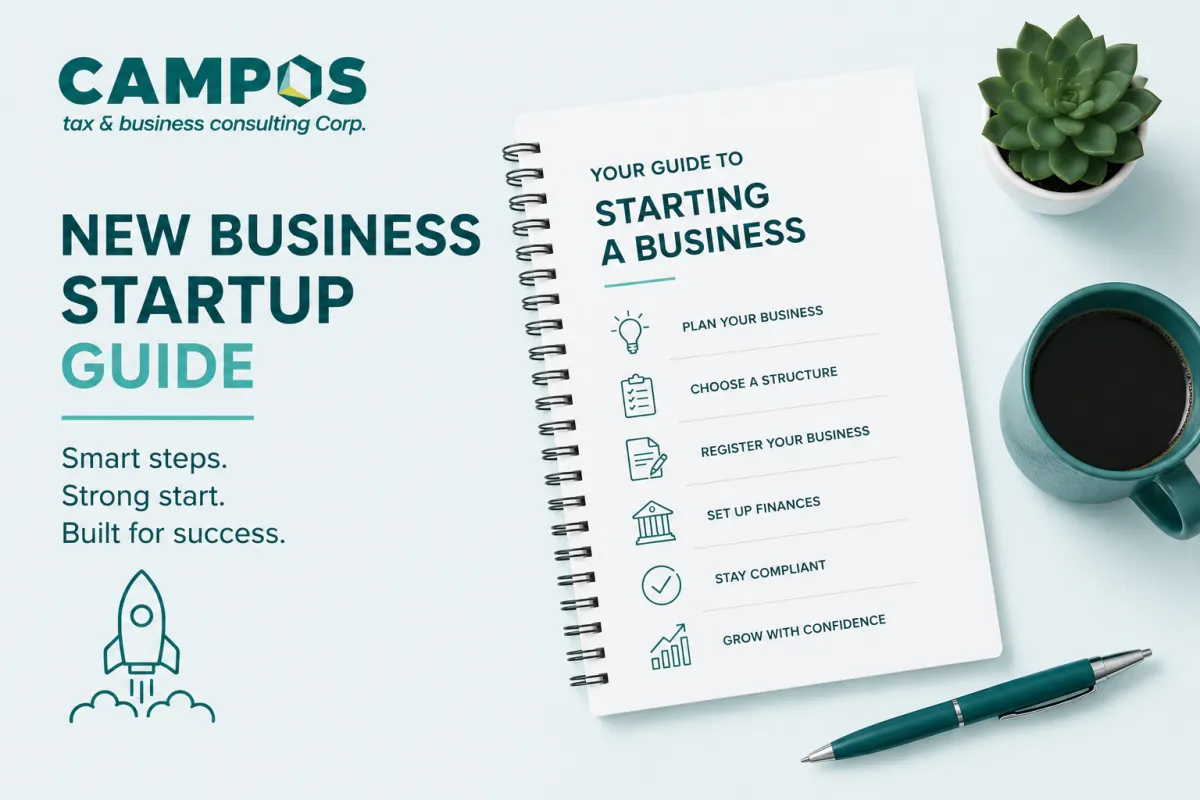
How to Start a Business in Ontario: Complete 2026 Guide
“This guide walks you through everything you need to know to launch your business correctly in Ontario.”
How to Start a Business in Ontario: A Complete Guide for 2025
Step 1: Define Your Business Structure
Step 2: Register Your Business
Sole Proprietorships and Partnerships
Trade Names and Operating Names
Step 3: Obtain Your Business Number and Tax Accounts
Step 4: Understand Your Tax Obligations as an Ontario Business Owner
Personal Tax Obligations (Sole Proprietors and Partners)
Step 5: Set Up Your Accounting System
Establishing a Business Bank Account
Step 6: Plan for First-Year Success
How Campos Tax Helps New Ontario Businesses
Other resources to help you get started with Business Registration
Question 1: Do I need to incorporate my business in Ontario?
Question 2: When should I register for GST/HST?
Question 3: What tax accounts does a new Ontario business need?
Question 4: How do I choose the right business structure?
Question 5: What records must I keep for my Ontario business?
Question 6: How much does it cost to start a business in Ontario?
How to Start a Business in Ontario: A Complete Guide for 2025
Introduction
Starting a business in Ontario is one of the most exciting decisions you will ever make. It is also one of the most complex — requiring decisions about business structure, registration, tax accounts, and operational setup that will affect your business for years.
This guide walks you through everything you need to know to launch your business correctly in Ontario. We cover legal structure decisions, registration requirements, tax account setup, and the foundational systems that support successful businesses.
Whether you are planning to operate as a sole proprietor, thinking about incorporating, or already have a business idea that needs structure, this guide provides the clarity you need to move forward confidently.
For entrepreneurs in Oakville, Burlington, Mississauga, Milton, and across the GTA, understanding these fundamentals helps you start your business on the right foot — avoiding costly mistakes that many new business owners make.

With that said, here are the best steps regarding starting a business in Ontario!
Step 1: Define Your Business Structure
The first and most important decision for any new Ontario business is choosing the appropriate legal structure. This choice affects your tax obligations, personal liability, administrative requirements, and access to certain business strategies.
Sole Proprietorship
A sole proprietorship is the simplest business structure — you and your business are legally the same entity. The business does not exist separately from you, which means you assume all liability for business debts and obligations. However, this simplicity also means straightforward tax filing — business income is reported on your personal tax return using a T2125 Statement of Business or Professional Activities.
Sole proprietorships are appropriate for businesses with low liability risk, part-time operations, and entrepreneurs who want to minimize administrative complexity while testing a business concept.
Partnership
A partnership operates similarly to a sole proprietorship but involves two or more owners. Partnerships require a formal partnership agreement to define how profits, losses, and decisions are shared. Each partner reports their share of partnership income on their personal tax return.
Partnerships are appropriate for businesses with multiple founders, where combining complementary skills creates more value than working separately.
Corporation
A corporation is a legally separate entity from its owners (shareholders). This separation provides liability protection — in most cases, shareholders are not personally responsible for corporate debts. However, corporations involve more administrative requirements and their income is taxed differently.
Canadian-controlled private corporations (CCPCs) benefit from the small business deduction, which reduces federal corporate tax rates on the first $500,000 of active business income. This structure enables tax planning strategies unavailable to sole proprietors, including income splitting with family members and income deferral.
Incorporation is appropriate for businesses with significant liability exposure, high-growth potential, or owners who benefit from tax planning strategies. Many professional service businesses, contractors, and entrepreneurs with substantial income incorporate for tax optimization.
Making the Decision
Your business structure choice should consider factors including liability exposure, income levels, growth plans, and tax optimization potential. An accountant can help you evaluate these factors and choose the structure that best matches your situation.
At Campos Tax & Business Consulting Corp., we help new business owners in Oakville and across the GTA evaluate structure options and understand the long-term implications of each choice.
Confused about which tax accounts your new business needs? We help entrepreneurs navigate CRA requirements from day one. Book a FREE consultation
Step 2: Register Your Business
Once you have chosen your structure, registration requirements depend on the type of business you are starting.
Sole Proprietorships and Partnerships
If you operate under your own name, no formal registration is required in Ontario. However, if you use a business name different from your legal name, you must register a business name with the Ontario government through the Business Name Act process.
Registration can be completed online through Service Ontario and typically costs around $60 for a five-year registration period.
Corporations
Corporations require incorporation through either the federal government or the Ontario provincial government (or both, depending on where you plan to operate). Federal incorporation creates a corporation that can operate anywhere in Canada, while provincial incorporation creates a corporation that operates primarily within Ontario.
Many businesses incorporate federally to ensure flexibility for future expansion. Incorporation can be completed through Corporations Canada (federal) or the Ontario Business Registry (provincial).
Corporations also require a registered office address and must maintain corporate records including articles of incorporation, bylaws, and shareholder registers.
Trade Names and Operating Names
Regardless of your business structure, if you operate under a name different from the legal name of the business owner or corporation, you must register that operating name. Banks, suppliers, and government agencies typically require the legal business name on contracts and accounts, so having a registered trade name does not eliminate the need to use your legal name on official documents.
Step 3: Obtain Your Business Number and Tax Accounts
Every new business in Canada requires a Business Number (BN) — a unique identifier assigned by the CRA that connects all your business tax accounts. Your BN is obtained when you register for your first tax account.
Registering for GST/HST
Most new businesses must register for a GST/HST account if they expect to exceed $30,000 in taxable sales within a single quarter or over four consecutive quarters. You can register voluntarily even if you expect to remain below this threshold, which allows you to claim input tax credits on business expenses immediately — particularly valuable if you have significant startup costs.
Registration can be completed through the CRA's Business Registration Online service or through a paper RC1 form.
Payroll Account Registration
If you plan to hire employees, you must register a payroll account with the CRA. This account tracks CPP contributions, EI premiums, and income tax withholdings from employee remuneration.
You must register within 30 days of paying employees. Registration can be completed through Business Registration Online or by calling the CRA's Business Enquiries line.
Corporate Tax Account
If you incorporate, your corporation automatically has a corporate tax account with the CRA. You will receive a notice of assessment confirming your account within several weeks of incorporation.
Import/Export Accounts
If your business will import or export goods, you may need additional accounts with the Canada Border Services Agency (CBSA) and other agencies. Your accountant or business advisor can help determine whether these accounts apply to your situation.
Confused about which tax accounts your new business needs? We help entrepreneurs navigate CRA requirements from day one. Book a FREE consultation
Step 4: Understand Your Tax Obligations as an Ontario Business Owner
Ontario businesses face several ongoing tax obligations that must be managed throughout the year.
Personal Tax Obligations (Sole Proprietors and Partners)
If you operate as a sole proprietor or partner, business income is taxed on your personal tax return. You must make quarterly tax installments if you owe more than $3,000 in taxes after credits and withholdings. The deadline for each installment is approximately 30 days after the quarter ends.
Corporate Tax Obligations
If you incorporate, your corporation pays corporate tax on its income at rates that depend on the type of income and your corporation's status. Federal corporate tax rates are 38% (reduced to 28% after the federal abatement), with the small business deduction reducing the rate to 9% on the first $500,000 of active business income for CCPCs. Ontario also levies provincial corporate tax at 11.5%, resulting in combined rates of approximately 26.5% for eligible small business income.
T2 corporate tax returns are due within six months of your fiscal year-end. For corporations with December 31 year-ends, the filing deadline is June 30 of the following year.
HST Obligations
If you register for GST/HST, you must file returns according to your assigned reporting period (monthly, quarterly, or annually). The HST you collect is remitted to the CRA, minus any input tax credits you claim on business expenses.
Starting in 2025, all GST/HST registrants must file electronically. Planning for this requirement means maintaining organized digital records from the beginning.
Payroll Tax Obligations
If you have employees, you must withhold CPP contributions and EI premiums from employee remuneration, match CPP and EI amounts as the employer, withhold income tax from employee pay, and remit all amounts to the CRA on schedule.
Step 5: Set Up Your Accounting System
A proper accounting system is essential for managing your business finances, tracking performance, and meeting tax obligations. The foundation of this system should be established before you begin operations.
Choosing Accounting Software
Modern accounting software handles most bookkeeping tasks efficiently. Options range from simple cloud-based solutions like QuickBooks Online and Xero to more comprehensive systems like Sage and FreshBooks. The right choice depends on your business complexity, industry requirements, and growth plans.
For most new Ontario small businesses, QuickBooks Online or Xero provides sufficient functionality without excessive complexity. Your accountant can often help you set up your chosen software and establish appropriate chart of accounts.
Establishing a Business Bank Account
Your business finances must be separated from personal finances. Open a business bank account immediately after registration — sole proprietors can use personal accounts for business transactions but separate accounts simplify bookkeeping and tax preparation.
Corporations absolutely must maintain separate corporate bank accounts. Mixing corporate and personal finances creates complications for tax filing, liability protection, and financial clarity.
Chart of Accounts Setup
Your chart of accounts defines the categories for recording income and expenses. Taking time to set this up correctly from the beginning saves significant time later. Your accountant can help establish an appropriate structure for your industry and business type.
Record-Keeping Systems
Establish systems for collecting and storing source documents — invoices, receipts, contracts, bank statements. Whether you use physical filing or digital systems (or both), consistency is essential. The CRA requires records for six years, so durable systems are necessary.
Setting up your accounting system correctly from the beginning saves time and stress for years. Let us help you establish systems that work. Book a FREE consultation

Step 6: Plan for First-Year Success
Starting your business correctly sets the foundation for long-term success. Several first-year considerations often catch new entrepreneurs off guard.
Cash Flow Management
Many new businesses experience cash flow challenges even when they are profitable on paper. Managing this requires understanding timing differences — when you collect revenue, when you pay expenses, and when you remit taxes. Building cash reserves and maintaining available credit help bridge gaps.
Professional Support
One of the most valuable investments new business owners can make is engaging professional support from the beginning. An accountant who understands your business type and goals can help with structure decisions, tax planning, and establishing systems that support growth.
Documentation and Contracts
Establishing clear documentation for customer agreements, vendor relationships, and employment arrangements protects your business. Written contracts prevent misunderstandings and provide reference points for disputes.
Compliance Calendar
Ontario businesses have numerous compliance deadlines throughout the year — corporate tax deadlines, payroll filing dates, HST remittance dates, and more. Maintaining a calendar of these dates ensures nothing is missed, preventing penalties and stress.
How Campos Tax Helps New Ontario Businesses
Starting a business is complex, but it does not have to be overwhelming. At Campos Tax & Business Consulting Corp., we help entrepreneurs across Oakville, Burlington, Mississauga, Milton, and the GTA launch successfully by providing the guidance and support that makes a difference.
Our startup services include business structure analysis and recommendations, incorporation support and corporate setup, Business Number and tax account registration, accounting system setup and bookkeeping training, and first-year tax planning and compliance support.
We work with businesses across industries — from construction and trades to professional services, from retail to technology — providing the personalized attention that new business owners need.
Ready to start your Ontario business with expert support? Contact Campos Tax and Business Consulting for a FREE consultation.
Conclusion
Starting a business in Ontario requires careful attention to legal structure, registration, tax accounts, and operational setup. By understanding these requirements and making informed decisions early, you establish the foundation for a successful business.
If you are planning to start a business in the Oakville area or across the GTA, contact Campos Tax & Business Consulting Corp. We help entrepreneurs navigate the complexity of business startup with expert guidance and ongoing support.
Other resources to help you get started with Business Registration
FAQ
Question 1: Do I need to incorporate my business in Ontario?
Answer: Incorporation is not required but may be beneficial depending on your situation. Sole proprietors and partnerships are simpler to operate and involve less administrative burden. However, corporations provide liability protection and access to tax planning strategies that can significantly reduce your overall tax burden. An accountant can help you evaluate whether incorporation makes sense for your specific circumstances.
Question 2: When should I register for GST/HST?
Answer: You must register for GST/HST if your business is expected to exceed $30,000 in taxable sales within a single quarter or over four consecutive quarters. However, voluntary registration is possible even below this threshold, and it can be beneficial if you have significant startup expenses where input tax credits would be valuable. Registration can be completed through the CRA's Business Registration Online service.
Question 3: What tax accounts does a new Ontario business need?
Answer: Most new businesses need a GST/HST account through the CRA. If you hire employees, you need a payroll account to manage CPP, EI, and income tax withholdings. If you incorporate, your corporation automatically has a corporate tax account. Your Business Number connects all these accounts and serves as your primary business identifier with the government.
Question 4: How do I choose the right business structure?
Answer: The choice between sole proprietorship, partnership, and corporation depends on factors including liability exposure, income levels, growth plans, and desired tax strategies. Sole proprietorships are simplest but offer no liability protection. Corporations provide liability protection and tax planning opportunities but involve more administrative requirements. Consult with an accountant to evaluate your specific situation and make an informed decision.
Question 5: What records must I keep for my Ontario business?
Answer: The CRA requires all businesses to keep records for six years from the end of the tax year they relate to. This includes source documents supporting income and expenses — invoices, receipts, bank statements, contracts, payroll records. Records can be maintained digitally if they are readable and accessible. Organized record-keeping also simplifies bookkeeping and tax preparation throughout the year.
Question 6: How much does it cost to start a business in Ontario?
Answer: Startup costs vary significantly by business type and structure. Basic costs include business name registration ($60-80 for sole proprietors), federal incorporation ($200-250), provincial incorporation (approximately $300), and legal fees for partnership agreements or shareholder agreements if applicable. Beyond registration, expect costs for accounting software, initial inventory, equipment, and working capital. An accountant can help you budget for the specific costs relevant to your situation.
External Authoritative Sources
1.CRA: Business Registration Online — https://www.canada.ca/en/revenue-agency/services/tax/businesses/topics/registering-your-business/business-registration-online.html
2.Corporations Canada: How to incorporate — https://ised-isde.canada.ca/site/corporations-canada/en/business-corporations/how-incorporate-business
3.Ontario Ministry of Finance: HST information — https://www.fin.gov.on.ca/en/hst/
4.ServiceOntario: Business name registration — https://www.ontario.ca/page/register-or-renew-your-business-name
5.Government of Canada: Business for individuals — https://www.canada.ca/en/services/business.html